Sunday, July 23, 2006


It's RAINING, it's POURING.....

I told Jon that last week it rained for 5 days straight when the tailend of a typhoon passed over Manila and he said he couldn't imagine what a typhoon (even the tailend) looks like. Well, today typhoon "Glenda" is passing by the northeast coast of Luzon (the Island Manila is on) so I can give you a bit of a description. I haven't experienced a typhoon by any means, but it's amazing to me the amount of rain even the outskirts of a typhoon bring!

I woke up this morning and noticed it was darker than normal. (Usually I wake up around 6 to bright sunlight streaming through the curtains, before I hide my head under the sheet and try to get back to sleep for another half hour). But this morning was gray and gloomy. And then I heard it - the unmistakable sound of standing directly under a waterfall. The rain was bucketing down on the tin roof of Sara's apartment - this was no light drizzles or gentle shower. I spared a thought for the clothes I had airing on the line (woohoo! They're being washed for me!) then rolled over and went back to sleep.

When I woke up again there was some anemic sunlight filtering through the clouds but I learnt last week not to be fooled. And indeed, by the time I got into the shower it was pouring again and I had not only the water from the bucket but also the water dripping from the ceiling and the stream coming in from the crack around the window to wash with.

I left the house with my pants rolled up to my knees. Not that the water was that high, but because flipflops kickup water and leave me with lines of splattered mud up the backs of my legs. They are also trecherously slippery, so that I was sliding all over the paved road as I walked.

By this evening though I need my pants rolled up because of the water. The main road through the neighbourhood looks like a river. In the middle of the road the water is only a couple centimeters deep but, at either side of the road are streams of fast-moving brown water, each over a meter wide and ankle-deep! It's amazing to think that this isn't even a real typhoon! The weather website I found describes the winds as "sustained strength of 150 kph near the center and gustiness of up to 185 kph". The center is forcast to pass over the northernmost island of the Philippines, so hopefully the damage won't be too great. I was chatting to a woman who works in a cafe near where I'm staying and she told me that last year when a typhoon passed over Manila her house was flooded up to her chest. She moved all her things up to the top floor and had to swim to get out of her house! Work was cancelled, I guess it's the equivalent of our blizzard days.

Still, the nice thing about the rain is that it cools off completely (it's only 26 degrees right now!) and for the first time since I got here I can almost imagine needing a sweater :)

I'm at the red dot (I think).


Not a typhoon but rain and wind in Iloilo.

Saturday, July 15, 2006

Hair

I got a haircut in Koronadal. I didn’t plan to get a haircut, exactly, but it’s funny how those things just happen. I took a wander in the Koronadal public market on Friday, which was a great experience. I thought “It’s amazing how me being on my own makes people much more likely to approach me” and then I realize that maybe it was that being on my own made me much more likely to approach them.

At any rate, as I was wandering down the stalls this guy (Cesar, I later learned) standing in front of his haircutting booth motioned me over yelling “Do you want to get your hair cut?” I’d been thinking about getting a trim, so really what could I say? (Anyone who thinks “No” is an answer – well, you may have a point.) But I said, ‘sure’ and plopped myself down in the chair.

So I’d said “just a trim, to here *gesturing with my hair*. No layers.” I should’ve known from my experiences in Canada that I can never get a cut with no layers. But I wasn’t actually expecting the Mrs. Brady type layering I ended up with first. And then when I asked if he could just cut the longest layer shorter (“Um, I just want my neck cooler?”) I didn’t exactly expect him to make every other layer shorter as well. Here, I’ve drawn you a progression:


Before, during and after.

I think it looks fine, actually, although Sara pointed out last night that when it dries one side is shorter than the other. Whatever, I’m happy with the story ;)
Ask a Filipino!

I haven’t forgotten about the “Ask a Filipino” questions, and I have an answer for Laura’s. Well, sort of. I chatted to an OSY in Iloilo about Laura’s question – “quote question” but this is a huge caveat to say that the second part of this answer is completely coloured by my interpretation because I found it really hard to bring the question up in a way that was clear to them or elicited a whole answer, if that makes sense?

So the straight answer to whether SCALA is seen an international …. Was “Yes, of course” and the reason why is “well, they told us so”. In the introduction to the program that the trainers give the OSY they’re told that the computers come from EWB, what EWB is, and how EWB has been involved since the beginning. And as the guy I was talking to said, “It’s right there in the name. Sharing Computer Access Locally and Abroad. That means international.”
But (and this is where my interpretation comes in) from chatting with him further he mentioned that he sees his peers, the OSY, and the trainers as the ones who make the program work. I think it’s seen as a project that local people (the DSWD staff) deliver, even if the origins are from an international NGO, although I’m not sure. I don’t think EWB is seen as directing the project day-to-day, especially since except for seeing Canadian EWB representatives at graduations our day-to-day presence is practically nil.
I wrote a description of the OSY, Luchie, who I stayed with for a week in Ormoc for a letter to be sent to NDI. I thought I’d post it here along with some other thoughts on the families I’ve stayed with:

Luchie is an OSY who just graduated from SCALA. She lives with her parents and four other brothers and sisters in a small neighbourhood on the outskirts of Ormoc. Her father drives a tricyle, which are still by far my favourite way of getting around.

Luchie's family was so welcoming – every night a crowd of people from the neighbourhood would flock to the living room and try to teach me Cebuano. There was a lot of laughter. Sometimes their hospitality made me a bit uncomfortable, since her family was pretty poor and gave me the best they had. To give you an idea – her family lived in a house that probably wasn't larger than my living room in Canada. My sleeping on the floor of one of the rooms with Luchie and her sister probably meant one more person had to squish onto the floor of the living room to sleep with everyone else. Still, they were the most gracious hosts. I wish I could have stayed longer than a week and gotten to know the family better.

Luchie is one of the brightest successes of the Ormoc centre so far. SCALA training consists of in-class computer training on the Office suite, internet, typing and life-skills (usually for about 3 months) and then an on-the-job placement for another 3 months or so. Luchie had her on-the-job training at the city government's General Services office and was offered full-time employment as a data encoder before her placement had even finished! Although it's interesting that the most important aspect of the SCALA program to her is the mentoring she received from one of the computer trainers. She started the program with very little motivation and kept skipping out on the classes. She says it was the talks she had with MaryAnn, one of the trainers, that really changed her attitude. I was at her graduation when she talked about that experience and by the end both she and MaryAnn were in tears. It was a really touching moment.

Luchie’s family was a big contrast with the family I stayed with in Koronadal. I was staying with Ate Luding, the budget officer at the regional DSWD, and her family. Again her familiy was very welcoming, but very difficult. The most obvious was that they were so much richer – kids in private schools, walls and gates around the house (which is really typical here), tons more food. Her way of hosting was very different too – in Luchie’s house I was always being asked to sit in the best chair, always being accompanied places, whereas Ate Luding had the ‘make our house your own’ way of hosting that I’m more familiar with.

Now, I’m not trying to say that the difference in hosting was related to the difference in income, or really trying to make any conclusions since these experiences are living in just two different families for short periods of time). But it made me wonder about where we learn the most – in Luchie’s house I think I was further outside my comfort zone (or at least further outside the realm of what I was used to). For example, I slept on the floor with two other people and was confronted daily with the fact that they were giving me the best of what they had (for example, probably more food than the rest of them were eating, although I was assured they were getting Food for Work for hosting me from the DSWD). At Ate Luding’s house I was in an environment I found much more familiar – I slept in a large bed I only shared with one other person and I was treated more like one of the family (although still confronted with the fact that the family had cousins living with them who, although the family was paying for their school, also acted as servants, and who objected every time I tried to wash the dishes or help with dinner). I was more able to communicate with Ate Luding though – for starters she spoke excellent English (Luchie’s mother didn’t speak any and my Cebuano is incredibly limited) and she was coming from perhaps a closer experience to mine, having done part of her studying at a University in Wales and working at the DSWD. So my question for you is how do you think one learns more? By being pushed outside your comfort zone or by being pushed less but able to communicate more? Thoughts?

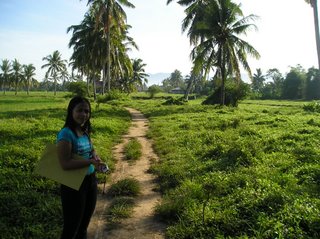
Luchie on the path from her house to the highway


Filipino Fruits, Part 4: Banana-q

Yup, I’m counting this as a fruit. The sweetest, most batter-covered fruit ever.

So the Philippines are kind of mean, in that they export the worst possible variety to us and save all the good ones for themselves. You can tell me it’s because the best ones won’t last on the journey all you want, but that doesn’t change the fact they kind of smirk when they describe just how tasteless their export bananas are ;) Most of the bananas her are small (or tiny, or teensy tiny) and sweet and each a bit different from each other….yummy. And I don’t even like bananas that much!

What I LOVE though, is banana-q. There are banana-q stands in every city I’ve been to, and they sell chunks of banana deep-fried in batter and dipped in sugar. The crust might differ – thin batter or bisquity batter or wonton wrappers, but the basic premise is the same: deep fried and covered in sugar. Mmmmmmmmmm.

Yes, I know I look ridiculous eating...


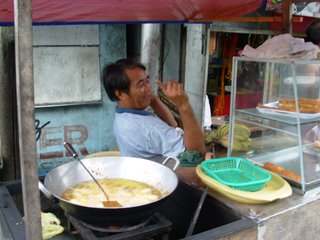
A banana-q vendor. Dancing :)