Tuesday, November 04, 2008

Waiting for the Rains

One of the nice things about being at school in the fall term was seeing the first snowfall through the classroom window. Of course the novelty and wonder usually wore off quickly (I remember one November a Prof. barely took the time to say ‘How nice’ before continuing to berate the class for doing so badly on the midterm), but waiting to see the first flakes fall was always exciting.

I’ve been feeling similarly these past few weeks as I wait for the rains to arrive in Malawi. I arrived in Malawi in March this year at the end of the rainy season. On my first bicycle-taxi trip into Dedza town I got caught in a sudden downpour and turned up to my first day at the office sopping wet. Since then there’s been no rain and Malawi’s undergone such a gradual transformation that I can’t remember what it looked like during the wet season. The trees and buses are still green, but the fields and roads have turned dry and dusty.

I’m not the only one impatient for the rains to come. Mrs. Boniface, my landlady, is up at 4 each morning to hoe her fields for a few hours before the sun gets really hot. She’s racing to prepare her fields for when the rains get here and can’t wait for them to arrive. The rains represent food for the coming year. Most of the fields in Malawi aren’t irrigated and so farmers rely on the rains - poor rainfall and a poor harvest means hunger in the coming year. Even with good rains and a bumper crop of maize last year the radio is reporting pockets of hunger in areas of Dedza district. While we were out walking this weekend Mrs. Boniface pointed out women coming down a path from Dedza mountain with impossibly large piles of wood balanced on their heads, telling me that selling firewood is what many women resort to raise money to buy maize when they’ve run out of their harvest.
Mrs. Boniface hoeing one of her fields (the ridges in the foreground are left over from last year, the ones in the background are newly hoed)

Mrs. Boniface's sister Aurelia hoeing, with Dedza mountain in the background

So good rains are a vital element of farmer self-sufficiency, but they can also be destructive. In part of my project’s working area the soils are very sandy and the rains cause latrines to collapse. When people go ‘free range’ instead of using a latrine the rains wash the ‘damages’ into streams and unprotected water sources, and cholera, diarrhea and other water borne diseases hit the villagers who rely on those sources for drinking water. Diarrhea kills 18% of the children under five who die each year in Malawi. Malaria (which accounts for another 14% of under-five child deaths) also hits hardest in the wet season as mosquitoes breed. It’s harder (and sometimes impossible) for extension workers to reach many villages as the dirt roads turn to mud.

So I’m waiting for the rains with trepidation as well as excitement. When lightening flashes across the hills at night I can’t wait to find out what the wet season in Malawi will bring.


And as a bonus....here's a picture of my little house (actually quite a big house for just me) in Kankudza village, Dedza, that I took this morning!


Friday, October 24, 2008

Bubbles

Here's another article written for the Iron Warrior. I don't have pictures yet of the Boniface family but I'll put some up soon!

During my five years in engineering at Waterloo I’d often find myself completely within the Waterloo bubble. At times my world consisted only of the lab, the systems hallway, the EWB office and Kismet. Things outside the bubble seemed far away and it was always a bit of a shock when events from the outside world (like the time I forgot my mom’s birthday) broke through the bubble. I was reminded of that feeling this past weekend when I visited my good friend from work, Loti. Loti has a TV and after a few weeks of living without electricity in my little village house I was looking forward to indulging. I switched on the international news station and was actually shocked to realize they were still talking about – were fixated, really – on the financial crisis.

Of course I had already heard all about the crisis, but at that moment I realized talk about it must be so much more omnipresent in Canada then it is in my daily life here. The Malawian newspapers cover it but their headlines are mostly captured by the roll-out of the national subsidized fertilizer program and the political jockeying taking place in the run up to next year’s presidential election. The effects of the crisis seem distant to me personally since my salary is already zero. And lately the bubble of my life hasn’t seemed to include bank bailouts and stock markets.

At the end of every day I walk home from the field office half an hour down a dirt road to the village of Kankudza. Usually I sit on the front step of the small tin-roof house I rent from the Boniface family reading my Chichewa lesson book until the light fades, then head across the road to the Boniface’s house. Mrs. Boniface, her sister, her two daughters and I squeeze into her kitchen hut, cook and eat dinner around her fire, share stories from the day and laugh at my Chichewa. They are my family here and little by little I’m connecting to their lives. Last weekend Mrs. Boniface took me on a tour of the dry-season garden she’s growing as part of an irrigation scheme supported by a local NGO and another day she told me about the 15 HIV positive neighbours she cooks for as a home-care volunteer. One night her daughters kept me up late teaching me the dances for a local wedding, but I’m usually in bed by 8 along with the rest of the village. Economic upheavals seems far away.

But that distance is an illusion – world crises and trends affect my family in this quiet village. The rise in the price of oil is one reason why the price of the fertilizer that Mrs. Boniface needs for her maize fields shot from 4000 kwacha per bag last year to 11,000 kwacha this year, putting it nearly out of her reach. All four of the countries to experience a financial crisis in the past 20 years dropped their foreign aid by at least 10 percent, and if that happens worldwide the funding for NGO projects like the microirrigation scheme that helped Mrs. Boniface create her garden may disappear. I can joke about my $0 salaray but Mrs. Boniface is so much more vulnerable; her ability to continue sending her girls to school, growing enough maize to feed her family and having the time to care for sick neighbours will weaken if she can’t afford fertilizer for her fields or loses the support of local organizations. Global troubles are coming a lot closer to this Malawian village than I realized.

Thursday, October 02, 2008

This fall I'm contributing articles to the engineering student newspaper at the University of Waterloo, and thought I'd post them here as well. Here are the first two...

Power and Action

If there’s one thing I miss about Canada, it’s the apple turnovers from the C&D. Ok, I guess I miss my friends and family a bit too, but they can’t really compare to that sweet apple-y deliciousness. Even the fresh fried banana fritters they sell on the streets here in Malawi don’t quite measure up.

Now imagine you’re standing outside the C&D, out of cash but with a powerful yearning for a turnover, and you ask your friend to lend you the money. He says sure, but only if you walk all the way down to the corner store his parents own at University and King and buy it there. You might protest that that’s not fair – it’ll take ages to walk all that way and his parents store only sells the hugely inferior cherry turnovers! But your friend won’t listen – either his money goes to a turnover from his parents store or you don’t get to eat.

The turnover analogy might be a bit flippant but it’s not that far off of what can happen with tied aid in development. One of my good friends at work, Loti, was listing the drawbacks of the pickup trucks that our water and sanitation project uses: they can only carry three people, they breakdown a lot and they can’t make it to many remote villages during the rainy season. He said that project management should have bought more robust trucks, so I asked the obvious question – why didn’t they? Turns out it’s because the main donor to the project stipulated that all the vehicles had to be bought from the donor country, and these sub-par trucks were the only choice. The same sort of tied aid conditions meant the project had major trouble finding a borehole drilling rig they were allowed to buy, putting them over a year behind schedule.

It’s Malawian villagers who pay the price when they have to wait an extra year for a borehole they need so that they can stop using an open pit as their well for drinking water. So the news that last week Canada untied all its aid made me prouder to be Canadian, especially a Canadian overseas. It also reminds me of the immense opportunities we have to take action in Canada. Advocate of untying aid had access to information about how our government spends its aid budget, could engage with MPs who would listen to them, and broadcast their voice through public events and media coverage. It’s something that any one of us can do on any issue if we want to, and my work is helping me see how rare and valuable that opportunity is.

I’ve just started working on a pilot called ‘Citizen’s Action,’ or Liwu la mzika in Chichewa, that’s trying to help villagers understand what water services they’re entitled to and demand those services from the governments departments and NGOs who are supposed to provide them. I was shocked to find out from a co-worker that the policies about water services (for example the one that says every person in Malawi should have a safe water supply less than 250 metres from their home) aren’t even widely available to district government employees, let alone to most villagers. So how can villagers hold their government accountable for providing water services if they don’t even know what services they’re supposed to receive? Who can they go to when an NGO promises to drill them a borehole but then doesn’t return to their village for over a year? Hopefully this pilot will help villagers find answers to those questions. It’s a small step towards helping Malawians access the kind of opportunity – to get information, to make their voices heard, to hold accountable the government and NGOs that are supposed to be working for them – that we enjoy in Canada, and the power to change their lives that comes with it.


Introductions

I’m sitting in a training centre in central Malawi. A warm breeze is blowing through an open window into a roomful of government health workers. Their eyes are glued to a guest facilitator from Concern Universal (my partner NGO) who is walking them through a new monitoring system that I’ve helped to design. I’m trying to appear attentive, but the truth is it’s hard to pay attention to training that’s being done in Chichewa (Malawi’s national language) when I so far have learned how to order a beer and say thank you. This training session is two days long, and when they’ve finished, the health workers will train 514 villages to fill out the new forms that go with this new system.

I graduated from Systems Design last year and the fact that I’m in this humid room, in a foreign country, listening to a facilitator I can’t understand seems perfectly normal.

Being a System Design engineer, I like feedback. It lets me know what’s going on in a system and whether or not the inputs I’m feeding in are giving me the outputs I’m looking for. Without feedback, us System Designers would be out of work, and those circuits labs would be a big waste of time, not just a big pain in the ass. But how do you get feedback from a system that’s unimaginably complex?

I work with a water project that deals with 514 villages – that’s over 200,000 villagers, who mostly farm maize and tobacco. They work hard, and CU tries to help them access clean drinking water and improve their sanitation. CU inputs new boreholes, subsidizes cement and trainings into this system of villages and hope that people will start washing their hands or covering their latrines with concrete slabs so they’re less likely to collapse. There’s little doubt that those are valuable outputs – it’s estimated only 64% Malawians have access to a basic latrine, and going ‘free-range’ means that the rainy season washes all those ‘damages’ as locals call them into water supplies. People use soap for cleaning dishes and their clothes, but rarely use it to wash their hands. (Disease data) But how does CU know if those outputs are happening? How do they get the feedback?

In the previous system that CU used, this was a problem. Monitoring forms were returned late or not at all by villages, the data was often wrong and staff didn’t know how to analyze or use the information they received. Two other EWB volunteers and myself worked with CU’s staff to create a system that helps villages track information so they can fill-in monitoring forms more easily and accurately, and most importantly has helped staff concentrate on the most important information they need and taught them skills to help them analyse and use it well.

This system is the first step in the partnership between EWB and CU. I learned the hard way in circuits that it’s not enough to get the feedback – if the little light at the end of your circuit doesn’t light up, you need to learn from it and change your circuit. It can be hard, when there are so many things that could be going wrong, and you only have 2 days to write your lab report, and you’re worried about your grades, to put the time into learning. It’s not that different for many Malawian NGOs, CU included - between meeting stringent reporting requirements, worrying about getting enough funding to keep afloat every year, and staff that is so busy with day-to-day activities they don’t always have time to learn from the information they get from the field. It’s vital that they do – we don’t yet know how to get people to wash their hands, or use latrines 100% of the time, and so CU needs to keep learnings. My vision for my placement is to help CU develop the processes and systems and staff skills it needs to be learning organization

Friday, September 26, 2008

The UN released a report yesterday on the world's progress towards the Millennium Development Goals that included the news that not one sub-saharan African country is on track to meet all of the goals. If like me you find the goals hard to visualize, check out Gapminder's MDG visualization thingy. (Thingy is the technical term). It's pretty awesome:

mdgs.un.org/unsd/mdg/Trendalyzer/index.html

I'm not sure how I feel about the MDGs - I wonder whether publicizing big-picture goals takes too much focus off of understanding the field-level details that need to be in place for the big-picture to be realized. Can we talk both about halving the number of people without access to safe water worldwide as well as the changes to incentives and motivations for government health extension workers in rural districts of Malawi that are needed before we can acheive it? I worry that the news that all the goals are unlikely to be met will overshadow the small steps that are happening on the ground (like the fact that the Malawian fertilizer-subsidy program looks like it will be somewhat better run this year over last year) and the learning that we should be doing from what has worked and not worked up to this half-way point to 2015. I also worry this report will lead to a 'blame the victim' mentality on the part of rich countries directed towards poor countries (and poor people) that will overlook the fact that the failure to acheive the goals is as much a failing of rich countries' to commit financially and of the global development system that needs to change. The thinking I fear is along the lines of 'We gave it out best shot and it didn't work. Lesson learned: we cannot beat poverty and we probably shouldn't try.' Heaven forbid the current systems and committment to development represent our best shot.

But if you want a warm and fuzzy feeling on top of worries and questions, load up the thingy, click Malawi and 'show trail' and graph access to improved sanitation versus infant mortality rates. It's what I did this morning :)

Monday, September 01, 2008

I prepared a flipchart showing my placement so far for the ’08 Malawi JF retreat, and I thought it might be useful to help shiny OVs envision what their first few months in a placement might look like. If this is helpful for you then great! If not, feel free to laugh at the drawings…
(CU is Concern Universal, my partner. They’re one of the major water and sanitation NGOs in Malawi. I’m based in the Ntcheu field office for their water and sanitation project)


My placement continues the work started by EWB volunteers at Concern Universal before me. Brett, with the short hair, was the first EWB volunteer at CU. When she started work as one of the EWB Southern Africa director Luke Brown and his square glasses finished out the last months of Brett’s year at CU before passing the baton to me


In this case the baton was the new M&E system Brett and Luke developed with CU staff. They designed new records to help villages keep track of how many sanitary facilities (latrines, hand-washing facilities, etc) they’ve built and new monthly and quarterly forms to report that information to CU. My first responsibilities were to help CU staff finish training villagers in the new forms and records and figure out how we should be using the new database to analyze the data.


One of the huge benefits of taking over the placement was that CU staff already had a lot of trust in Brett and Luke that they transferred to me. This is Loti, the training and monitoring officer I work with closely. We had a pretty great relationship from the start, which means I feel like I can ask him all my questions, and he asks me a lot in return.


As I started working on the data analysis part of the new system, I started thinking a lot about how people were actually going to learn from the information from the new system and act on it to adjust the way this project or future projects is implemented. I realized that the graphs I was designing in Access were only one part of helping people transform information into knowledge – I think people’s ability to increase knowledge is also affected by their skills (e.g. critical thinking), the constraints they’re under in the organization (e.g. whether they have the resources to act on their new knowledge), or whether they have the time to discuss or reflect on knowledge


A lot of this thinking crystallized into an 'A-ha' moment after I had attended a few staff meetings. I noticed that during meetings staff would bring up lots of valid points about the challenges they were facing but meetings rarely finished with a clear plan for how to solve the issues.


My hypothesis based on this a-ha moment was that if meetings continued like this then the staff would have trouble discussing the data they get from the new M&E system in a productive way that allows them to create plans to adapt to what they learn from the new system and follow-through on those plans. In that case, the new system would have limited usefulness, no matter how much effort I put into producing clear graphs and data analysis. So I started having conversations with people at work about how to address this issue.


Based on these discussions I split my work into two areas -continuing to design graphs and reports using the database, as well as looking at teambuilding and facilitation skills. I had my first meeting with the manager in the Ntcheu field office where I'm based, and we agreed to have weekly coaching facilitation skills coaching sessions. We've also started planning a multi-day teambuilding workshop for the project staff that will focus on the most common issues they identify that make it difficult for them to be a high-performing team. I feel like the Ntcheu manager and I are both aiming for the same mountain peak although I'm not sure exactly what path we'll take to get there.


I’m still working on designing the data analysis tools for the system, which to me represents three things: a tool that the project staff can use to better understand what’s happening in the villages; time, because by using the database to quickly analyse monthly data I can save the monitoring officers time each month that they can instead hopefully spend on reflection or digging deeper into issues; and a cake, in that the graphs and reports I design will be the first thing I give to CU that I know they want, and so I feel it’ll help me establish my credibility


I’m also coaching two JFs, Emily and Janelle, who are assessing how well the new M&E system is working at field-level. They’re being managed by the monitoring officers, and I think I’ve seen an increase in Loti’s confidence and skills because of it. Loti and I have weekly coaching/check-in sessions so that he feels supported in taking on this new management role.


A big concern of mine is that time seems to go at triplespeed in Malawi, and that if I don't focus on the data analysis it'll drag on too long! I've realized that the 6 months I have left in my placement will go by incredibly quickly! I'm seriously thinking of extending my placement, but even so I need to get a move on!


So now, about 6 months into my placement, I have a wholelot of questions to answer. What's useful in what I'm doing to building the EWB team and direction in Southern Africa? Do I have the skills to execute on the two tasks I've started or do I need to bring in other people? How do I maintain relationships and presence at the two field offices in Dedza andNtcheu as well as at head office in Blantyre (without living in a minibus)?And where should I live? (I tried out living in a village family for a month but found the lack of English and the amount of traveling I was doing hard to balance, so now I'm looking for a new place to live. I have some good leads but haven't moved in anywhere yet, so at the moment I'm staying with Loti).

And most importantly - what balance can I strike between building CU's ability to execute their projects by building management capacity and helping them learn about and adapt the approach they currently take with their projects?


All of these questions feed into the decisions I have to make about where I want to focus my efforts for the rest of my placement (which I cannot believe will be over in 6 months!) When I'm finished with designing reports in the database I could work on the district wide sector-planning and citizen's action initiatives that CU is just starting in Dedza, or work on designing the M&E system for a new upcoming water and sanitation project at CU, or do a post-project impact assessment of a project they finished three years ago. I want to make sure that what I work on feeds in to improving management capacity at CU and helping the organization to better learn about the strengths and weaknesses of the approach they're taking.

Monday, May 26, 2008

Radio SA SA

(SA being Southern Africa… weak pun, I know) It’s been radio silence around here for quite a while, for which I apologize! To make it up to you lovely people, you get three posts for the price of one! A field-guide to sanitary facilities, a description of my new home life and some bonus musings. A post with details about what I’m actually doing here is in the works, so check back soon. Just to remind you – I’m generally free to chat from 6am to 8am and 5pm to 8 pm my time, so feel free to call or email! (Send me an email if you don’t have my number).

First a mini-update on my life – the short-term volunteers from EWB arrived two weeks ago, and after running around a bit to get them introduced at CU I’ve been back for my first full week in Ntcheu in a while. The major story in the Malawian news right now is the xenophobic violence breaking out in South Africa (http://news.bbc.co.uk/2/hi/africa/7415507.stm). The newspaper reported on the first confirmed Malawian killed last week, although it’s also being reported that a lot of identities can’t be confirmed because people have lost their ids. A lot of my friends here have friends in South Africa who they’re worried about, especially since the violence seems to be spreading to new cities without warning, or who are planning to come home. The paper this morning said the first busload of people organized by the Malawian government returned yesterday. The other huge story is that Muluzi, the head of an opposition part of Malawi and former President, has been arrested on treason charges (http://news.bbc.co.uk/2/hi/africa/7419946.stm)

At the moment I don’t have pictures for my post about my family, but I’ll try to post some next week!
Sanitation 101


I spent a week in April in Samanyada village, about a 15 minute drive outside of Ntcheu .It was nice to put day-to-day work on the M&E system on hold and spend some time connecting with villagers involved in the project. Getting to know a community of welcoming, friendly people was also exactly what I needed to feel like I was starting to find a home here in Malawi. It was also good to see Concern Universal’s project from ground level.

Concern Universal works with villagers in Malawi to encourage them to build sanitary facilities that can help protect/improve their health. But what exactly are sanitary facilities? Lukily during my village stay I was able to observe sanitary facilities in their natural habitat, and so I can bring you Campbell’s Field Guide to Sanitary Facilities – Malawi.

The ‘Big Two’ of sanitary facilities in Malawi are the improved pit latrine and the hand-washing facility, which ideally live in close proximity to each other.

The improved pit latrine evolved from the traditional pit latrine (which is also an ancestor of the Canadianis Outhousis), its primary improvement being a cement sanitary platform (sanplat) that covers the top of the pit. The sanplat opening has a cover, allowing the improved latrine to control odour and prevent flies from escaping from its pit and spreading disease. The close cousin to the improved pit latrine, the ventilated improved pit (VIP) latrine, has further evolved a ventilation pipe attached to the pit to further control odour. A fly screen at the outlet of the pipe allows the VIP latrine to trap flies.
The hand-washing facility relies on its forked-stick body and brown clay bowl to help it blend in with the natural environment. It has a plastic cup or bottle with holes punched in the bottom that releases a steady stream of water. The most used hand-washing facilities have developed symbiotic relationships with flowers that take advantage of the water flowing from them. Unfortunately there are some concerns about how many hand-washing facilities are actually used in the wild.
My friend Tinyade demonstrates!

There are, in addition to the ‘Big Two’ supported by CU, a number of sanitary facilities not mentioned in the project document that are nonetheless promoted in the field and measured by the M&E system – sort of the zebra muscles of sanitary facilities, if you will.

Bathing shelters have a distinctive texture due to their walls of grass or reeds. Field researchers have predicted that in the cold months of May and June loud yelps will issue from the bathing shelters as Canadian volunteers experience their early morning bucket showers.

Malawian kitchens can be attached to the main dwelling or in a separate building. They usually contain a charcoal stove or 3 stones to balance pots over an open flame.

The dish rack spends most of its day basking in the bright Malawian sun, allowing the dishes that perch on its back to dry and preventing standing water from collecting.

Finally, the common drying line is found across the world without much variation in population ;)
Home Sweet Home

Adam asked a good question a few months ago, about how it feels to be here and doing things like finding a family to stay with in Ntcheu. I didn’t have a good answer for a while – when I first arrived in Malawi I spent a lot of time with Luke Brown, the EWB volunteer working at CU before me, getting myself up to speed on all the work he and Brett Stevenson had done at CU before I arrived. Since we only had two weeks and were often working at night it made sense for us to stay at the house of our CU colleague Loti, where we had electricity (as well as a fence around the yard, satellite tv and a houseboy who cooked and insisted on doing my laundry). It wasn’t quite the level of integration into Malawi life that I was looking for, so once Mr. Brown headed back to law school in Canada I commenced my search for a family…..
The adventure begins…

There’s a very intriguing road by Loti’s house leading into the villages outside of Ntcheu. One sunny Saturday I headed down it. Down the hill and across a bridge, I ran into a friendly elderly man. We walked along, having a conversation in garbled Chichewa and English that neither of us really understood. (I thought he was telling me he worked at a high school library, I realized later that he thought I wanted to go visit the high school library when he ordered one of his grandchildren to escort me there). Eventually we came to his house, and he introduced me to his wife. She gave me a pumpkin.

The next day I came back with Loti in tow as translator to ask if this man knew of anyone in the village (Kandoda village) who might have a room I could stay in. After a discussion with his daughter and her husband, who had a house in the same yard, they decided the best thing would be for me to live with the daughter, Len, and her husband, Mr. Maganga. It took a much longer conversation to convince them I should pay them anything for rent or food, but eventually we agreed that I would move in once I got back the next weekend from my week-long village stay, and that I would pay them 500 kwacha a week for food (that’s $3.60 a week, and I couldn’t convince them to let me pay them more!)

(Adam mentioned that he would probably feel intimidated knowing he had to find a family, and it really struck a chord with me. Finding a house was one of the big scary things I couldn’t imagine myself doing before I left Canada. Even as I was talking to my future host parents I was incredibly nervous, in addition to being excited. A lot of the reason why I felt brave enough to go out and just talk to people was because I knew I had a safe, comfy home base at Loti’s house and could ask him to translate, otherwise I would have been lost!)

Actually, a funny story from the other day proves how lost I would’ve been without Loti to translate. The EWB short-term volunteers arrived in Malawi 2 weeks ago, and a few days ago I introduced Janelle, the volunteer who’ll be working with CU in Ntcheu this summer, to a friendly lady who has a stall in the market. I embarked on a conversation in my rudimentary Chichewa to ask where this lady lives and explain that Janelle is looking for a family to stay with in Ntcheu. She seemed surprised and amused, and said she would let us know next morning. The morning after her husband was waiting as we approached. He came up to Janelle with a big smile on his face, shook her hand warmly, and said “So, I hear you want help finding a husband!”


…the adventure is interrupted…

I travel a lot between the two project field offices (in theory an hour apart in Dedza and Ntcheu, although in practice up to three hours accounting for waiting for a minibus and all the stops a minibus makes along the way to drop off and pick up passengers!) so it was only two weeks later that I was back in Ntcheu and ready to move in with the family. Then Mr. Maganga came to Loti’s house one morning to tell us that he had moved out of the compound he shared with his father-in-law, because he suspected the environment was making his kids sick. (I don’t know exactly what he meant by this, but I suspect that there was no latrine at the compound, something I had forgotten to check when I agreed to move in). He said he had moved into neighbouring Benne village in a house next to his mother’s, and that I was welcome to move into a room in her house. I checked it out, we agreed on a trial period of a month, and three weeks after meeting the Magangas I moved in with them.

… and continues…

I have a very small room in Grandma Maganga’s (I call her agogo, or grandma) house all to myself, with nails to hang my clothes on, a handy hoe handle stuck under the roof thatch to hang my mosquito net from, and a reed mat and blankets for my bed. I sometimes share my room with a cat, the guinea pigs that my agogo raises, or the rooster who seems to sometimes sleep in the house. (It’s my animal magnetism ;) My agogo sleeps in the other bedroom with 3 or so kids, and two other kids sleep in the third room in the house.

My room!
Agogo's houseAgogo Maganga

I rarely spend time in the house though unless I’m sleeping or changing clothes, and I think of the courtyard outside the house as my living room and the veranda-like step that encircles each house as the couches. There are five houses opening onto the courtyard – my agogo’s house, Mr & Mrs Maganga’s house that they share with 4 or so kids, and three other family homes with about three kids each. I’m not actually sure how the other three families are related to the Maganga’s yet – my Chichewa isn’t good enough to ask and the Maganga’s speak barely any English.My living room!

Len has a kitchen building in which she cooks, and the other families cook on hearths on their porches. There’s also a latrine and bathing shelter in the courtyard, made out of grass.
The latrine (on the left) and bathing shelter

Benne village is at the base of Mt. Ntcheu, and usually I arrive home at dusk after the sun has gone behind the mountain. Usually Len has already finished cooking the relish for dinner (relish is anything eaten with nsima. The maganga’s can’t afford much meat so we usually have canola leaves, pumpkin leaves, small dried fish or beans) and is boiling the water to cook nsima. After dropping my bag in my room and greeting everyone else, I usually sit be the fire or on the veranda and try to chat. Sometimes I bring out my Chichewa guide and the kids pronounce words for me. Ayerson is my particular favourite for this – he’s about 10 and as far as I can tell he’s the only one of the kids who goes to school. (I asked Len why the two girls who are old enough don’t go and she said it’s because they don’t feel like it. Ayerson seemed to say it was because they can’t afford the uniform fees, so I’m not sure if I really understand yet.) Ayerson’s English is a bit better, and he sits beside me and tries to translate things for me. (Yesterday at dinner, out of the blue, he piped up with “Baby cow – mwana ng’ombe.” There wasn’t a baby cow in sight, but I’ve stored it away for a time when I need one :)Ayerson washing his feet before school.

Everson, the baby of the family, is also a complete cutie. He’s about 18 months, and he likes nothing better than playing with my phone. He’s even started saying ‘Hewo, hewo!’ into it, which cracks the family up.
Len Maganga (on the right) with Ever

We sometimes eat in the house and sometimes sitting on the verandah and the ground of the courtyard under the stars (the nenyeze). We dip our hands in a bowl to wash them and eat out of communal bowls of nsima and relish (although Mr. Maganga sits somewhat apart and has his own bowls) I like eating outside the best, with my hoodie on and my chitenge wrapped around my legs tight because it’s getting quite cool at night. Eating in the moonlight can result in some surprises though, since it’s hard to see what the relish is. Once, as I dipped my lump of nsima into the relish I thought I felt slivers of pumpkin, which was quite exciting, but I was bitterly disappointed when I popped it into my mouth and realized it was small whole fish! After dinner we chat for a bit, and then head to bed. I’m usually in bed by 8:30 and asleep soon after!

I usually wake up between 5:30 and 6 am, now that I’ve learned to sleep through the rooster that starts crowing outside the curtain in my doorway at 4 am. I seem to have been given (or maybe I took) the chore of sweeping the courtyard in the morning, which takes about half an hour. By that time, Len has heated the water for my splash bath (she or one of the girls collects it from the borehole pump at the school, about a minute’s walk away), and I bathe, dress, eat a bun and drink some tea, and head out by 7 am. I stop by Loti’s house to pick up my laptop and usually grab another cup of tea, then I head into work for 8. It’s a 5-ish minute walk from the Maganga’s house to Loti’s house, and Mr. Maganga usually insists on accompanying me. Then it’s a half hour walk to work, although I sometimes catch a ride with Loti on his motorbike.
One of my host sisters, Chipililo, sweeping the yard.

The Magangas make clay pots for a living, so Len is sometimes already working on them when I leave in the morning. (Actually, so far I haven’t seen Mr. Maganga working on the pots, so I’m not actually sure what he does during the day, although he’s told me he doesn’t have another job).Clay pots drying in the yard. These will sell for about $1.50

A neighbour smoothing the surface of a pot.

… where will it end?

I’m nearing the end of my month’s trial period with the family and I’m not sure if I’ll stay with them much beyond that. Partly that’s due to work pressure – I think it’ll make sense for me to spend a few weeks in mid-June in the CU head office in Blantyre getting to know the people there, which will mean leaving Ntcheu for a while. Also, I don’t know if this living situation will make me happy in the long run – not necessarily for the reasons I might have expected. The food is great, I feel healthy here, I get a good night’s sleep on my mat and I feel like I connect with my family despite the language barrier. But I also find it difficult to balance my life at the house with my life in town – it gets dark here early and so when I’m home after dark I stay there, which can make it hard to find time for my other friends in Ntcheu. I do really value the look into village life that I’ve gotten with the family – it’s especially neat for me to see how they use water and hygiene. (To give you an example – CU promotes hand-washing facilities to get people washing their hands. My family doesn’t have a hand-washing facility but I have often noticed Len washing her hands with the water soaking in the dirty dishes that sit outside the kitchen during the day. That makes me wonder whether it would be better to work with what people already do, like by encouraging soap use with the dish-water, rather than encouraging new facilities that might be seen as less convenient.) No matter where I end up living, I hope to keep a connection to this family.
Mind the Gap

Most days, I hold two worlds in my head -my life in Canada and my life in Malawi - that seem to mesh together easily. I go to bed on a mat in a mud house, and just before I sleep I have a quick phone call with a friend from Canada. I wake up to roosters crowing, I sweep the yard of bits of clay, stray beans and kernels of corn, chwed bits of sugar cane and a discarded plastic package of Malawi Gin, then on my way to work stop off at Loti’s house and watch the morning headlines on the French news channel he gets by satellite. On my way to the internet café to send emails and look up resources for work I buy bananas from women wearing chitenges and sobey’s t-shirts, and we chat a bit in Chichewa. The bright sunlight at noon somehow reminds me of watching baseball games, although I also enjoy it for its own sake. My host family jokes that I should take the baby, Everson, back to Canada with me.

Then sometimes these two worlds jump apart. One night last week, as I was finishing dinner with my family, Mr. Maganga asked me how much it costs to fly to Canada. I ballparked in my head - $1500 ticket, 140 kwacha to the dollar – about 200, 000 kwacha. Shock. Exclamations of disbelief. It was as if I’d just announced that people in Canada sometimes had green or blue skin as well – something completely unimagined and unbelievable, that they were going to have trouble reconciling with the me they saw sitting on their floor. Len’s follow-up question was how many weeks it took to get there, and (I think) whether I went by bus. Ayerson noted that a car costs 90,000 kwacha, and no one in our neighbourhood has a car. A radio costs 1,800 kwacha and I think (although I’m not sure) that the radio that appeared at the Maganga house after I moved in was due to my first rent payment.

(I don’t really have anything to summarize this or give it much meaning, but it was an experience I thought I’d share with you)

Thursday, April 03, 2008

I’m turnin’ Portugese, I think I’m turnin’ Portugese…..

One of the truly neat things about Dedza and Ntcheu (apart from the mountains, cool temperatures and guavas) is that they’re both very close to the Mozambique border. In fact, there’s a stretch of highway between them that essentially is the border. Driving along it you can see buildings on the one side that were partially destroyed in the Mozambiquan civil war (some still have Portugese signs on them) while the other side is Malawian. (I’d like to read more about the civil war, so if anyone has any book suggestions post a comment!) I’ve been told that since the administrative centres of Mozambique are so far from the Malawian border, for all intents and purposes the people living along the Mozambique side are Malawian.

At any rate, with the border so tantalizingly close I was entertaining thoughts of jaunting across and visiting Mozambique. That was before I accidentally and illegally entered the county.

It all started when I boarded a mini-bus from Ntcheu to Dedza to meet up with Luke for the first time. He gave me clear instructutions to get out at the first Dedza turn-off (Dedza, unlike Ntcheu, is somewhat off the highway) and to take a bicycle taxi (you sit on a carrier over the back wheel and put your feet on two handy footrests) to the Dedza bus depot that’s right by the Dedza CU office. Unfortunately, the police check-point next to the big sign that says ‘Dedza’ is NOT one of the Dedza turn-offs, but it is where I jumped out of the mini-bus. I got a bicycle taxi driver who hardly seemed to speak any English, but since he’d discussed directions with a police officer who did, I hopped onto the bike feeling fairly confident.

My first hint that something was terribly, terribly wrong was when we reached an incredibly steep paved road and went screaming down it at top speed. Luke had mentioned that the ride in was ‘nice and relaxing along dirt roads’ whereas I was clutching the bike seat in terror, praying the bike wouldn’t fall apart. We eventually coasted into a deserted parking lot with a few vendor stand opposite. I walked up to one of the vendors and asked where the bus depot was. He looked at my blankly, asked his friend something, then burst into laughter. Turns out my bike taxi had taken me to the Mozambique side of the road, and not into Dedza at all.

So I hopped back on, and we proceeded back to the highway, then over it, then through all the backstreets of Dedza while my bike driver tried in vain to find the bus depot. At one point, we ended up inching along a narrow strip of grass with the wall of a housing compound on one side and a deep sewage ditch on the other. That was when the heavens opened and started to pour rain. We ended up jumping the ditch, and I eventually squelched into the CU office and asked for a place to change my soaking clothes. (It wasn’t the first-day impression I wanted to give but I don’t think they’ve held it against me.)

Now, I’m not completely sure whether I actually got to Mozambique or not, but I like to believe I did. I also like to hope that the next time I visit I’ll be slightly more legal and slightly less lost :)

Saturday, March 29, 2008


Specializin’

I was sitting in a one-room brick building in a village a 20-minute drive from the main highway with Jonathan, one of Concern Universal’s Water and Environmental Facilitators. He had just finished running the morning session of a training for two new village water and health committess, and we were eating a nsima and chicken lunch provided by the committee members. We were discussing his job with CU and he looked at me very seriously and announced, “We are much specialized in feces.”

……Ok, maybe he didn’t say it too seriously.

For the past two weeks I’ve been hanging out with self-described specialists in feces – or rather the Water and Environmental Sanitation (WES) project staff at Concern Universal. After a brief stop-in at the CU head office in Blantyre, I headed to beautiful Dedza, where one of the CU field offices for the WES project is located. I spent a week there, and then this week I was at the other field office in Ntcheu.

Now, I can show you these places on a map….


….but that really doesn’t do them justice. I’ve heard a rumour (or is it more?) that J.R. Tolkein visited Malawi before writing the Lord of the Rings, and Dedza is one place where you could believe it to be true. It’s surrounded by mountains, and while the pictures I’ve taken so far don’t do it justice, you’ll just have to trust me that it’s a pretty neat place. Ntcheu has fewer beautiful mountains, since it’s lower in elevation, but it compensates by having riper, more delicious guavas.

In Dedza & Ntcheu I’ve been trying to get to know all the people involved in the WES project and start to understand what they do and how they fit into the monitoring & evaluation system I’ll be working on for the project. In real life that mostly means I’ve been having one-on-one chats with everyone from Health Surveillance Assistants (HSAs), the government workers who help CU deliver and monitor their project in individual villages, to the project and programme managers. I’ve also been trying to get out to the field with project staff as much as possible.

My trip with Jonathan was to sit in on a day of community based management training he was giving to two new village committees. In the morning they discussed the responsibilities of the committee positions they’d just been elected to earlier in the week, and in the afternoon they finished learning to cast sanplats (the cement covers for improved pit latrines). Since the training was in Chichewa I didn’t add much, although I did provide the entertainment – about halfway through the morning session, a little boy who had been sitting in the front corner got up to leave the room. He got to the end of the row, saw me sitting by the door, screamed MAMAAAAAAAA!! (or the Chichewa equivalent) and bolted up the second row to the safety of his mom. His reaction was pretty extreme but it’s not unusual for small children to burst into tears at the sight of me :)

At the moment it’s the lean season in Malawi – the time of year before maize has been harvested when people’s reserves of maize are at their lowest. One of the women in the village I was visiting with Jonathan commented how hungry people are right now, and I’m impressed that people will sit for hours in a hot classroom and are able to learn about committee roles when that’s the case.

My trip to the field with Alinane, a facilitator from Ntcheu, was to check on a school sanitation club (CU works with some schools to build latrines and promote student sanitation clubs) and some existing village committees. It was especially exciting because, on the way back to the office, we stopped in to see a launching ceremony for a tree-planting income generating project. In this video, the women are singing some political songs (I’m not exactly sure what about) before the closing speeches begin. (Video will be posted when Megan gets a better internet link)


In my spare time, I’ve been trying to download Luke Brown’s brain into mine – Luke is the EWB volunteers currently on the project. He’s leaving at the end of this week, which is kind of scary. I’m also excited to start connecting to Malawi more on my own – the last few weeks it’s like I’ve been experiencing ‘Malawi lite’, out of the necessity of handing over everything that Luke knows to me I’ve been spending most of my time with him and have been focused on work. It has been nice to get introduced to a ready-made community of Luke’s friends and to get comfortable in Ntcheu and Dedza before having to find a place to stay, but I think I’m ready for the next steps! I’m planning to spend the second week of April in a village, and I’ve decided I’ll be based in Ntcheu for the next couple of months, so I’ve started putting out feelers for a family to live with. The nice thing about Ntcheu is that even though the centre of town is pretty much a stretch of the main highway, a short walk away from the highway gets you into pretty villages. I plan to go exploring an find a place to live!

(Posted by Megan’s Dad, her internet connection is none too swift)

Thursday, March 06, 2008

It turns out the rainy season in Malawi isn’t quite over. I’m writing this on the porch of a backpacker’s hostel in Lilongwe, and the heavens just opened. I’m hoping it stops soon because I want to walk to the clothing market to buy some skirts for work (and possibly an umbrella ;)

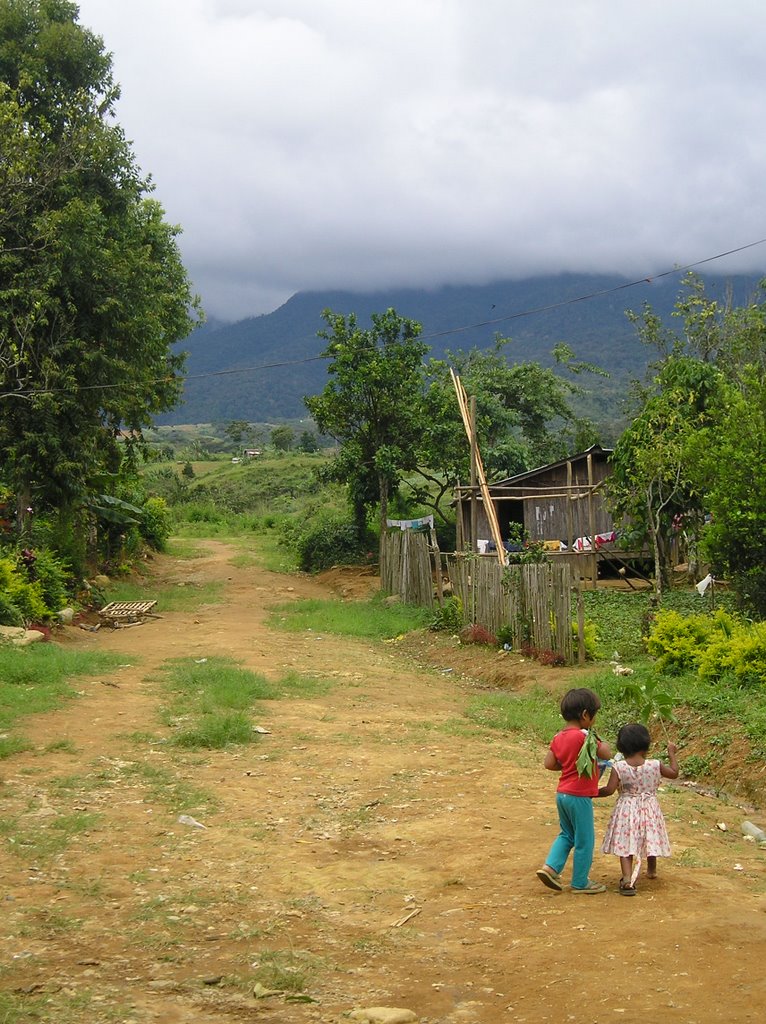
Rain or not, I’m really happy to finally be in Malawi! We (me, Brett, one of the directors of Southern Africa for EWB, and my fellow new volunteers Graham and JP) arrived 2 nights ago. Before that, we spent a week in Lusaka with the rest of the new Southern Africa volunteers getting over jet-lag and learning a bit more about Zambia and Malawi and the work EWB volunteers do there.

My favourite parts of training were the days when we left the hostel and explored Lusaka. One day we went on a scavenger hunt for stories and pictures, and another day we were sent out to learn about the maize value chain and how it could be changed to help market nshima vendors be better off. (Nshima is the staple food in Malawi & Zambia – it’s made of maize flour and it kind of resembles mashed potatoes except thicker. You eat it with meat or vegetable relishes, which are really good, and unless I mention otherwise you can probably assume that I’m eating it everyday from here on! Value chains capture all the steps that add value to a product like maize, as well as the inputs and supporting institutions that make the steps possible. Hans will be working with value chains with PROFIT)

I was nervous about going on the scavenger hunt because I had a bit of a vision of ‘scary, unsafe Zambia’ in my mind, and because I wasn’t sure how people would react to being asked about the things on our list. I mean, one of our items was to visit a compound clinic (a compound is like a suburb of Lusaka) and ask about HIV testing and counseling and I wasn’t sure if people would even want us to ask about HIV.

As it turned out, it was a wonderful, fun experience. Graham and I went to the Kalingalinga compound (fun to visit AND fun to say!) and almost everyone we met was happy to talk to us, and polite if they didn’t. I met Hicks on my way out of the clinic. (I have pictures of these people but unfortunately can't upload them at the moment!) He’s a member of a support group for HIV positive people, and just went on antiretrovirals. (My understanding is that now that Zambia’s debt has been cancelled, antiretrovirals from government clinics are provided free for anyone with a CD4 count below 200, which I’ve heard is comparable to Canada’s standard for providing the drug. I hope I’m not getting that wrong…) He had just been out in the fields trying to convince people to get testing and counseling, and kept emphasizing that the most important thing for him is good nutrition, since otherwise the antiretrovirals aren’t very effective.

On the minibus back from Kalingalinga Graham and I accidentally started a debate between two gentlemen about whether Motorola or Nokia is the better cellphone, and by the time we got off the bus we had two volunteer guides to help us around the market. After so much kindness, when we went out to talk to nshima vendors a few days later I was less surprised when Sofina, one of the nshima vendors, told us all about her finances and then escorted us around the market to see where she buys her maize flour and her charcoal. (She and a few other nshima vendors we talked to said one of their big difficulties is that they can't buy maize flour or charcoal in bulk).
So tomorrow I meet my new boss at Concern Universal and I’m a tiny bit terrified. I’ve started hearing about some of the really exciting opportunities in this job (helping ensure the pilot project for the monitoring & evaluation system is sustainable, spreading the system to other projects, and EWB possibly getting a grant in the summer to look at the impact of a Water & Sanitation project a few years after the project has finished) but I can’t imagine yet how to actually work towards any of them! At any rate, I should have lots to share with you soon.

PS – for anyone who wasn’t reading this blog while I was in the Philippines, the defining moment of my first week there was when I flooded a bathroom. (The story’s in the archives). I am EXTREMELY happy to report that thus far I have not damaged any Zambian or Malawian property, nor have I created any waterfalls in any more bathrooms. Of course, I’ve got a whole year here, so we shall see…..

Wednesday, December 26, 2007


So what exactly will I be doing in Malawi? A lot of you have been asking me that, and I'm not a very good person to answer the question, since I don't completely know! What I do know is I'll be working with Concern Universal (CU) in Malawi in the water and sanitation sector. Concern Universal's website is on the link list to your right, and for the really eager their annual report on their Malawi activities is at here.

Part of the challenge of my placement will be figuring out how I can add value to Concern's organization, but I do know I'll likely be focusing on the monitoring and evaluation of their projects. Brett Stevenson worked with CU last year, and there's a great description of her work here. I love how part of her work was encouraging CU to measure development as more than just the number of latrines built or wells installed, but as the positive impact it can have on people's lives. I'm very excited about continuing with CU, and about being in Malawi! It's a small country of about 12.6 million people, (BBC country profiles) and all the volunteers to Malawi I've talked to say it's a beautiful country. It certainly looks like it, judging by the pictures from Kim's blog:I'm looking forward to telling you more soon!

Sunday, December 09, 2007

Raffle Time!

Part of being an EWB long-term volunteer is fundraising a small part of what it costs EWB to send me overseas ($500). I want my fundraising to let people know that I'm going overseas and get you coming to my blog so that you'll visit again once I start posting stories. (See the post below for what I'll be doing overseas!) So don't worry if you can't or don't want to donate, just come back in the new year for more stories! If you would like to donate, then I'll enter you in a raffle draw for these fabulous prizes!

*drumroll please*

You have the chance to win one of two malongs, which are wraps from the south of Mindanao island in the Philippines, or a bar of Fair Trade chocolate!

I'm asking for a minimum donation of $5 a ticket, but really I appreciate whatever you can donate! I'll make the draw by January 7th and get the prizes to you!

You can donate in three ways:
  1. Donate online (send me an email afterwards so I can tell EWB your donation should go towards my fundraising)
  2. Deposit online to my bank account (I'll email you the numbers on request)
  3. In person! (Send me an email and we'll meet up!)
Thank you for reading and I'm looking forward to having a lot more to tell you in the new year!

Friday, August 18, 2006

Videoke Love


Stop laughing. I love videoke. LOVE it. I have a deep and abiding passion for videoke that I don’t think would even be possible in Canada. In Canada we treat karaoke as something to be ashamed of – we sing it self-consciously, with irony. We abuse karaoke, basically – we laugh at it and hurt its dignity and when we’re done we forget about it until the next time we’re drunk. We’re callous and karaoke deserves so much better.


But here, people love videoke with the passion is deserves. Here people sing it without shame, without irony. People take videoke seriously and sing it with abandon. People in the
Philippines treat videoke right and it rewards them with the freedom to sign, badly or well, the way only an atmosphere of true love can.


But if you’re a Canadian in the
Philippines (you callous brute) and videoke decides to give you a second chance, you’re going to need to take some advice. Hence, three rules for videoke novices:

  1. Knowing a song’s chorus does not mean you know the song. In fact, main melodies are often quite different from the chorus. You can try that song you “think” you know, just realize that the only sociable reaction to the embarrassed silence that ensues when you realize you don’t is to pass the mike off to someone who does.
  2. The key you think a song is in is not the key the videoke machine thinks the song is in. Transpose, or be prepared for some spectacular octave jumps.
  3. Don’t wait to enter your song numbers. You may think you need some time before choosing a song to get into the videoke groove. That is because you’re a videoke novice. Everyone else at your table has 3 or 4 favourites already queued up. So has everybody at all the other tables. So if you hesitate, you’ll be waiting for your songs long after your friends are finished, feeling slightly ridiculous for making people wait so you can sing ‘Piano Man’.

You’ll need some songs, too, and while that’s an intensely personal decision people make within their relationship with videoke, I hope you can learn from the top 17 songs that bring meaning to Megan’s videoke experience:

  1. Total Eclipse of the Heart – Bonny Taylor
  2. Making Love Out of Nothing at All – Air Supply
  3. Like a Prayer – Madonna
  4. Girls Just Wanna Have Fun – Cyndi Lauper
  5. Africa – Toto
  6. Without You – Air Supply. (Air Supply is one of those bands most people don’t realize you know until you hear them. I cant’ liiiiiiiiiiiiiiiiiive, if living is without you……)
  7. My Humps – Black Eyed Peas (Ok, I’m a little ashamed of this, even here.)
  8. Material Girl – Madonna
  9. Bang Bang – Sonny and Cher
  10. Eternal Flame – The Bangles
  11. Narda – Kamikaze (I’m trying to learn more Tagalog songs, but there’s so many syllables, so little time.)
  12. Can’t Take My Eyes Off You – Frankie Valli
  13. Piano Man – Billy Joel
  14. It Must Have Been Love – Roxette
  15. Sweet Caroline – Neil Diamond
  16. Time After Time – Cyndi Lauper
  17. I’ll Be – Edwin McCain

There you go – Air Supply, Madonna, and a bunch of one-hit Wonders. Videoke loves me just the way I am :p

Filipino Fruits #Something: Macupa

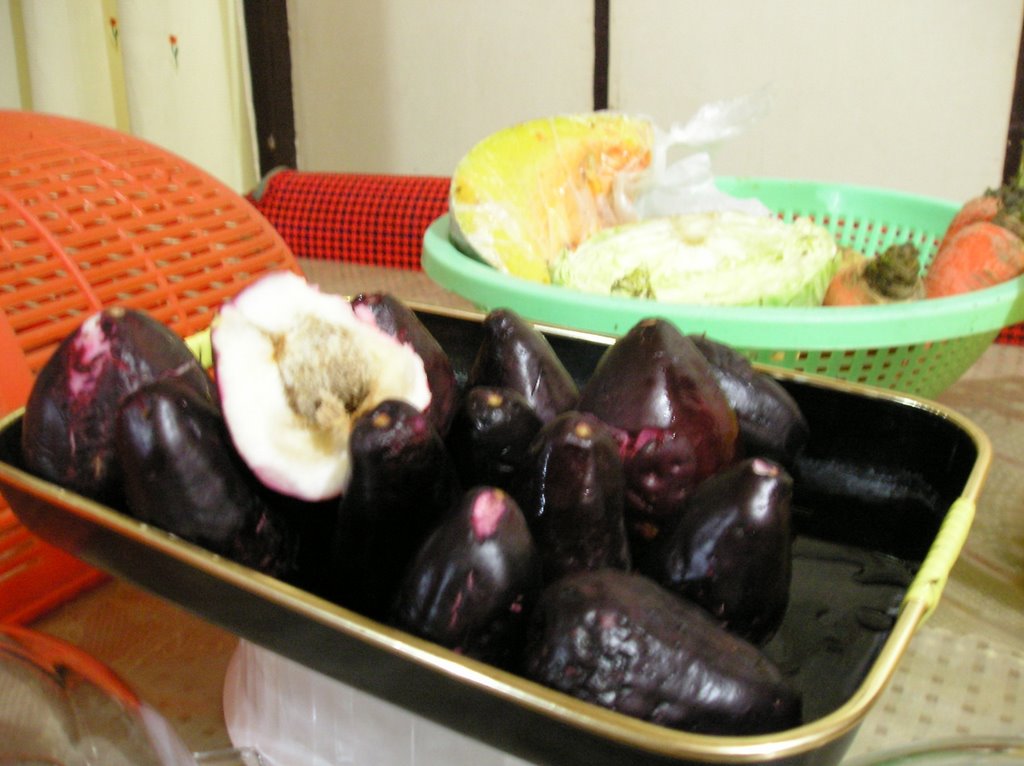
I was thinking about what Filipino Fruit Rajat would like (there, do you feel better my liege?) and I think Macupa is it. It looks like a bright maroon pear, with white, sponsy flesh and a big round seed in the middle. It’s a bit sour unless you get the ripe ones which have a deep fragrant flavour, almost like eating a particularly delicious rose. It’s hard to describe. But there’s a macupa tree in the yard of my house, so I’ll do some more research and get back to you.

I got laughed at so much for arranging this picture

Roles & Responsabilities

I thought I had gotten used to being conspicuous here in the Philippines. People (especially kids) call out ‘Hey Joe!’ or ‘Americana!’ all the time, but it’s all friendly. I hadn’t realized how used to the way people stare until I was in a mall in Koronadal with Lieka, my SCALA partner, and she was shocked by how everyone was staring at me while I didn’t think they were staring that much.

Still, when I rode into Malaybalay on the bus and a guy on the sidewalk stopped dead, elbowed his friend in the ribs and pointed at my window, I realiazed I might be a bit more conspicuous here than in Manila. Then a couple of weeks ago some elementary-age girls from the neighbourhood stood outside the gate watching me read. They giggled for 15 minutes before asking me to buy a ticket for their school raffle. How could I pass up the chance to win a sari-sari store? (Although it’s telling that the grand prizes are a tricycle and a small store). When I came back out of the house instead of 3 girls there were 9 plus a couple of toddlers. Lots of giggling ensued.

A while later I was back inside and heard my name being called through the open window. I went out on the porche and there were 15 kids crowded around the gate and a little girl in front waving a book and pen. “Megan, Megan!” she called, “Autograph!”

Oh man.

Later that evening my host family was still teasing me for having refused (nicely, I hope) to sign an autograph. “For them it’s like a movie star is living in their neighbourhood! They’ll remember this forever!” I think they get while I don’t’ want to act like a movie star, even if that’s the case, but that doesn’t stop them from teasing me to wave like a pageant queen out of bus windows.

This is the pretty innocuous, friendly end of the spectrum. At the other end you have the Regional SCALA Focal Person announcing, as she introduced my Filipino partner Ronaldo (a trainer from Ilo-ilo) and I to the SCALA team in Malaybalay, that they are soooo lucky because they’re the last set-up to get a Canadian volunteer and future centers will have to make do with two Filipino volunteers. Then she forgot Ronaldo’s name.

Ok, so that’s an extreme example. I was talking to Nocnoc (Ronaldo’s nickname. Filipino nicknames rock! So far I’ve met several Bongs, a Nars, a Dodong and the supremely satisfying Bonky). Anyway, I was talking to Nocnoc because it was bothering me the way the host family always asks me what I’d like to do on the weekends or what I’d like to eat but don’t ask him. I figure he’s a guest here also, but he sees himself more as my host as well. And when we got on the subject of the Focal Person’s comments and the way people address their questions to me instead of him he said that now it’s part of the culture here for a lot of people to treat Westerners like that. He also said that in some ways he thinks it’s a good thing – the fact that Canadians were pushing the SCALA project probably made it more likely to be accepted. His opinion is that it’s harder for Filipinos to refuse a Westerner suggesting a project without feeling ashamed. I don’t know how true that is here, although certainly the head of the DSWD really pushes me front and center (compared to Nocnoc) when he’s trying to sell the project to the Governor or Vice-Governor.

If it is true, I don’t know that I agree with Nocnoc that it’s a good thing. On the one hand, if as Westerners we’re supporting projects that are needed and well-thought out and our involvement makes it more likely those projects are adopted, that might be a positive thing. But how well are we really able to judge that the projects we’re supporting will have a positive impact? And furthermore – I feel it’s a big responsibility to back a project knowing it’s more likely to be accepted because we’re involved rather than based on its merit. I’ve gained a better appreciation here for how resources are finite – in South Cotabato one of the trainers had been taken off her previous job as the social worker for abused women and children to become a SCALA trainer. She thought a replacement would be found for that job but it hadn’t been found yet. Does EWB’s involvement give SCALA a higher priority than it should have based on it’s merits, and if so are we able to, willing to or aware of taking on that responsibility? (It’s a bit of a moot point as EWB has moved out of doing its own projects and into supporting existing local projects, but how does that question extend to other Western development groups?)

Avocamole

Last Friday evening found me eating guacamole with a spoon. I had to, because Noc-noc had dumped all the chips into the bowl and mixed them in. Forget learning to speak Visayan, guacamole is the key to acceptance in my host family ;)

I didn’t really expect people to like it. Martin made it in Iligan and apparently it went over like a lead balloon. People in the Philippines consider avocado to be a fruit, and they either eat it plain or mixed and chilled with sweetened condensed milk as desert. (By the way – try it, it’s delicious!) Whe I said it was treated more like a savoury in Canada people actually gasped.

But now, in 5 days I’ve been asked to make it 3 times and I think my family and the SCALA trainers are well on their way to being addicted! (Even if, reading the recipe before she’s tried it, one of the trainers asked, “so, it’s a type of gravy?” They’ve also decided that the name “guacamole” doesn’t make nearly as much sense as “avocamole” :)

So I’m in Malaybalay, the capital city of the province of Bukidnon. I got here on July 24th so obviously I’m ridiculously behind in posting this blog! My only excuse (but oh, it’s a doozy) is that the center set-up here has been “interesting”, to say the least. (In this case, “interesting” means that on the one hand the trainers here are awesome and strong in both computers and teaching and the center manager has great ideas. On the other hand, we’re still working on getting our set-up budget and the venue prepared and before Wednesday every one of the four identified trainers had full-time jobs that didn’t include training the youth once the center launches. Why yes, there are only 2 working days left before I leave, thanks for asking).


But this is an entry about where I am! Malaybalay is a great city – smaller than the other cities I’ve visited. (I mean, there’s no mall! I know the Ben and Cat are going to freak out if they read that but I haven’t been in a Filipino city yet that didn’t have a mall. ‘Malling’ (window shopping and hanging out at the mall) is a pretty popular pastime here). The city is also very green, apparently the result of a government green-ci
ty campaign. We’re up in the mountains so it’s cooler than almost anywhere else in the Philippines, and cooler than Toronto by a long shot :p Filipinos call Malaybalay the “mini-Baguio”, Baguio being a place in the mountains in Luzon that’s the coldest place in the Philippines. It’s cool enough here (I haven’t seen a thermometer since I arrived so I can’t say how cool except that I need a sweater sometimes and a blanket at night) that pine trees grow, and it’s a little strange for me to see pine trees growing next to huge stands of bamboo in the forests! There’s also a large Indigenous population in the province – 7 different tribes and languages under the umbrella term ‘Bukidnese.’


This is also a mainly agricultural province – Dole and Del Monte both have huge banana and pineapple plantations here (and not only are their export bananas tasteless compared to the local ones, they’re also covered in plastic bags while growing on the tree to prevent blemishes. Sorry!). A lot of the people here either work on the multinational plantations or are subsistence farmers.


The gap between the two typs of farms is huge, as you can imagine. I went with Jo, a population worker for the government, to her home
municipality of Sumilao. It’s about an hour away on the main (only) highway, and then we went another 12 km along a bone-rattling road to the barangay of Lumpiagan. Lumpiagan is one of the poorest barangays in the province. It’s a handful of houses perched on the top of a cliff overlooking a small, deep valley. On the sides of the valley and the cliffs opposite are peoples’ fields. Some of the fields here are on hills so steep I wonder how the farmers keep their footing when they plant or, when they harveset their cabbages how they keep them from rolling down to the bottom of the valley.


Jo was there to give a talk to the barangay youth on how to make banana chips, as part of a livelihood program. I have to wonder though, is knowing how to make banana chips that useful when those youth have to walk 12 kilometers to get to Sumilao to sell them? It’s a hilly road, and Jo says it takes her at least 2 hours to walk if she takes a shortcut over the side of a steep hill. Their remoteness is why most of the youth from the barangay are out of school – the nearest high school is in Sumilao, and if their families can’t afford to board them there high school kids have to spend at least 4 hours a day walking there and back. A lot of them drop out to start farming instead. Jo also told the kids about SCALA and hopefully some of them can take advantage of it. The municipalities have agr
eed to cover the cost of board and lodging for their SCALA participants in Malaybalay as well as the cost of transport to get them there, which for the kids in Lumpiagan is essential.


After visiting Lumpiagan we continued on to a ranch whose manager Jo is friends with. It’s owned by one of the rich families in the area and the difference between it and the farms in Lumiagan was overwhelming. This place was huge – and was raising Kobe beef to sell in Manila for a thousand pesos per kilo. (To give you an idea of the shock of that, regular beef here costs about 100 pesos per kilo). The ranch manager was really knowledgeable about farming in the region and the chance to get on a horse for the first time in a long while was great, but it was an unreal afternoon. Two very different sides of life around Malaybalay, that’s for sure

Lumpiagan

Steep fields.